



Finding a factory is easy. Finding a manufacturing partner you can trust with your brand for the next ten years is not. This guide walks you through the exact 7-step process professional buyers use to vet eyewear manufacturers in China — with the questions to ask, the documents to demand, and the red flags that should send you walking away.
China produces the majority of the world’s eyewear, and the Wenzhou–Shenzhen–Danyang corridor is where most of it happens. For emerging eyewear brands, distributors, and retail chains, sourcing from China offers unbeatable combinations of cost, capacity, and craftsmanship.
But every sourcing manager has a horror story: the “factory” that turned out to be a two-person trading company, the samples that looked nothing like the bulk order, the shipment that missed the season by eight weeks.
The difference between a nightmare and a partnership is process. Here is the 7-step framework we recommend to every brand that asks us how to source eyewear from China — written from the manufacturer’s side of the table.
Step 1: Define Your Product and Business Model First
Before you contact a single factory, get clear on what you actually need. Manufacturers receive hundreds of vague inquiries (“I want to make sunglasses, send me your catalog”) and they all go to the bottom of the pile. Serious buyers get serious answers.
Define these four things:
- Product category: sunglasses, optical frames, reading glasses, or sports eyewear — and the material (acetate, metal, TR90, PC, titanium, or a combination).
- Business model: Are you developing custom designs (OEM), customizing a factory’s existing designs with your branding (ODM/private label), or buying ready stock to test the market? Each path has different MOQs, lead times, and costs. If you are not sure which model fits your brand stage, read our detailed breakdown: OEM vs ODM Eyewear Manufacturing: The Complete Guide for Eyewear Brands.
- Target price point: A factory needs to know whether you are building a $15 retail product or a $150 one. The materials, hardware, and QC standards differ completely.
- Estimated volume: Your first order quantity and your 12-month projection. This determines whether a factory can prioritize you.
A one-page tech pack or even a clear reference sample photo puts you ahead of 90% of inquiries.
Step 2: Verify You Are Talking to a Real Manufacturer — Not a Trading Company
This is the single most important filter. Trading companies are not inherently bad, but they add margin, slow communication, and — critically — they cannot control quality on a production floor they do not own.
How to verify a real factory:
- Business license check: Ask for the Chinese business license (营业执照). The business scope should include 生产 (manufacturing/production), not only 贸易 (trading) or 批发 (wholesale).
- Factory address vs. office address: A real manufacturer operates from an industrial zone, not a serviced office in a city center. Check the address on satellite maps.
- Live video factory tour: Any genuine factory will happily walk you through the production floor on a video call. Refusal or endless postponement is a red flag.
- Ask detailed process questions: Ask about their polishing process for acetate, their hinge insertion method, or their coating lines. A trading company’s salesperson will deflect; a factory engineer will talk for twenty minutes.
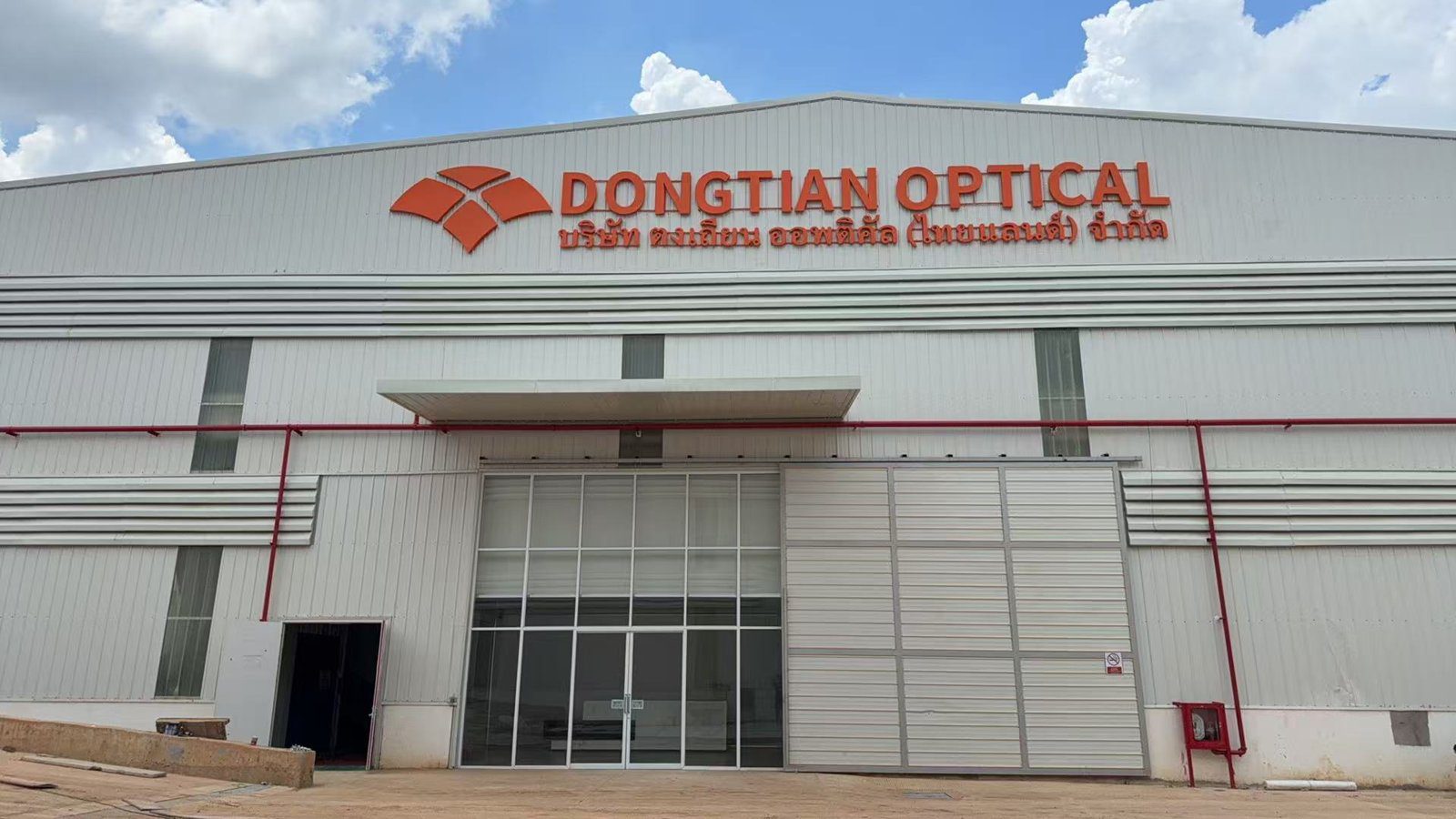
A manufacturer’s own facility, like our Wenzhou plant above, should be visitable, verifiable, and proud of its signage. If a supplier hesitates to show you where your products will actually be made, walk away.
Step 3: Audit Production Capacity and Equipment
A factory that is too small cannot scale with you; a factory that is too large will never prioritize your 300-piece orders. You need the right fit — and honest numbers.
Key capacity questions to ask:
| Question | Why It Matters | What a Good Answer Looks Like |
|---|---|---|
| How many production lines do you operate? | Reveals scale and material specialization | Specific numbers per material (e.g., “4 lines: acetate, metal, PC/TR90, plus an in-house lens workshop”) |
| What is your monthly capacity per material? | Tests whether they can absorb your growth | Concrete figures, e.g., 150K acetate / 700K PC pieces per month |
| How many workers and QC staff? | Indicates whether QC is a real department or an afterthought | Dedicated QC team (at a 1,000-worker factory, expect 80+ QC staff) |
| What machinery do you own in-house? | In-house tooling = faster sampling and stable quality | CNC machining, injection molding, metal tooling, tumbling and polishing lines under one roof |
| Do you have backup facilities? | Supply chain resilience | Some manufacturers now operate secondary plants (e.g., in Thailand) to hedge tariff and logistics risks |
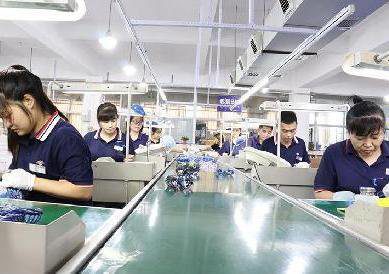
Ask for photos and videos of the actual lines that will produce your order — not a highlight reel. Pay attention to workplace organization, worker PPE, and whether stations have posted quality standards. These details predict consistency better than any sales deck.
Step 4: Evaluate the Quality Control System
Every factory claims “strict quality control.” Few can show you the system behind the slogan. A reliable eyewear manufacturer should operate at least three QC gates:
- IQC (Incoming Quality Control): Raw materials — acetate sheets, metal wire, lenses, screws, coatings — are inspected before entering production.
- IPQC (In-Process Quality Control): Line inspectors check critical points: frame dimensions, bridge alignment, temple symmetry, coating adhesion.
- FQC/OQC (Final & Outgoing QC): AQL sampling (typically AQL 2.5/4.0) before packing, plus functional tests.
Ask to see the testing lab. A serious eyewear factory owns physical testing equipment, for example:
- Hinge durability testers (open/close cycles)
- Nickel release testing (mandatory for EU market)
- Salt spray / sweat resistance testers for metal frames
- UV and light transmittance testing for lenses
- Drop ball and impact resistance tests (FDA 21 CFR 801.410 for the US market)
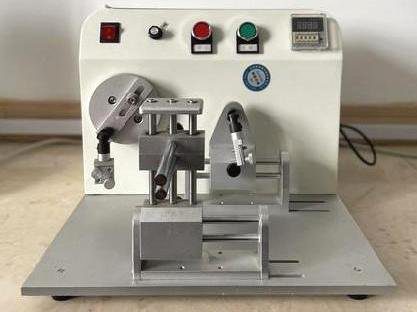
If a factory outsources all testing or cannot name the standards they test to (ISO 12312-1 for sunglasses, ISO 12870 for optical frames, ANSI Z80.3 for the US), their “strict QC” is marketing, not engineering.
Step 5: Verify Certifications and Compliance
Certifications are the closest thing to objective third-party proof you will get before placing an order. Demand the actual certificate documents — then verify the certificate numbers with the issuing bodies.
The certification checklist for eyewear sourcing:
| Certification | What It Proves | Market Relevance |
|---|---|---|
| ISO 9001 | Documented quality management system | Baseline for any serious factory |
| CE | Product compliance with EU safety standards | Mandatory for selling in Europe |
| FDA registration | Compliance for the US market (impact-resistant lenses, registration) | Mandatory for the United States |
| BSCI / SEDEX | Social compliance: labor conditions, working hours, safety | Required by most European retail chains |
| GRS | Verified recycled material content | Essential if you market sustainable/eco collections |
| HIGG / FEM | Environmental performance of the facility | Increasingly requested by large brands |
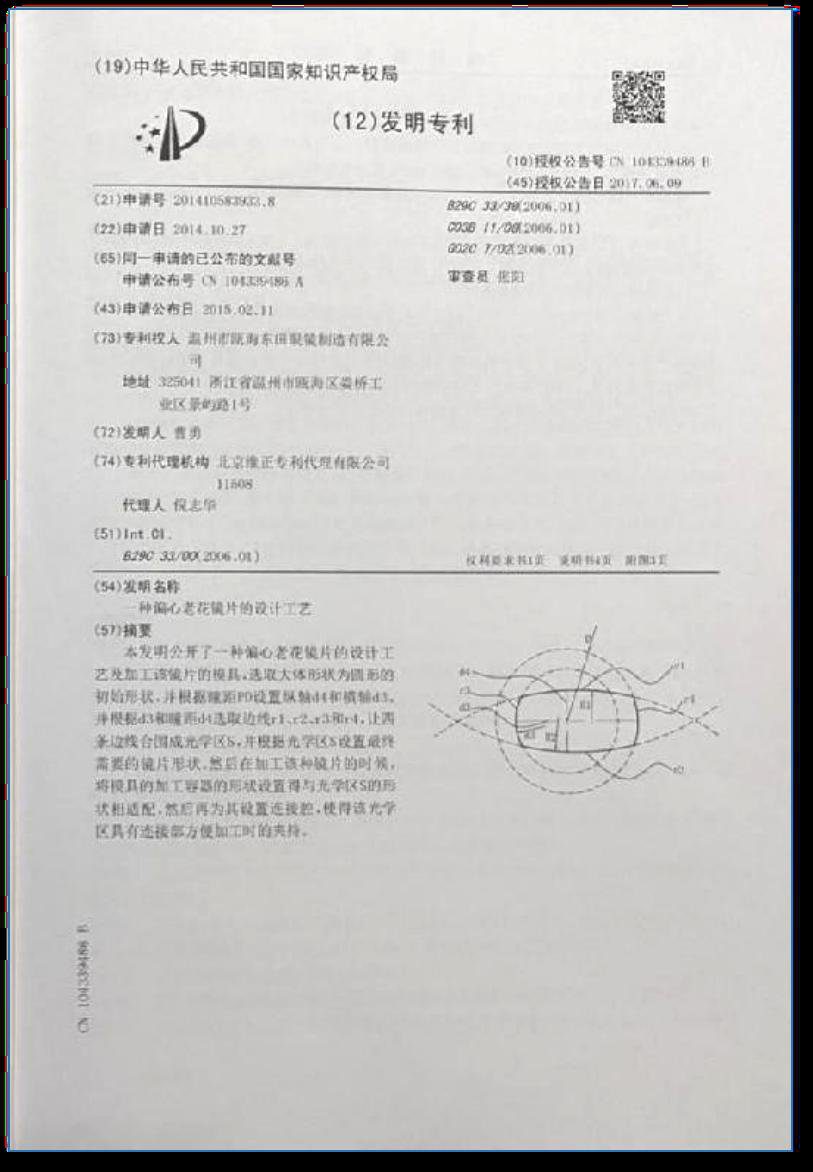
Two warnings. First, a certificate for one factory does not cover a different address — multi-plant groups should hold certifications per facility. Second, check expiry dates. An ISO 9001 certificate from 2019 that was never renewed tells you something about how the company treats standards.
Also ask which brands and retail chains already audit them. Factories that pass Costco, Walmart, or major European optical chain audits have been vetted far more rigorously than any buyer visit you could conduct yourself.
Step 6: Test Communication and the Sampling Process
Your sampling experience is a rehearsal for your production experience. Watch how the factory behaves when the stakes are small, because that is how they will behave when the stakes are large.
What good communication looks like:
- Replies within 24 hours with substantive answers, not just “noted, thanks.”
- A dedicated merchandiser or project manager who owns your account.
- Technical questions get routed to engineers, not improvised by sales staff.
- Transparent about problems: a good factory tells you a material is out of stock before you discover it on the production schedule.
The sampling checklist:
- Confirm sample lead time in writing (typically 7–15 days for ODM samples, 20–30 days for OEM tooling-dependent samples).
- Order samples in your exact target materials and colors — not “similar” ones.
- When samples arrive, measure everything against the tech pack: dimensions, weight, hinge torque, logo placement, coating color under natural light.
- Ask how many revision rounds are included and what they cost.
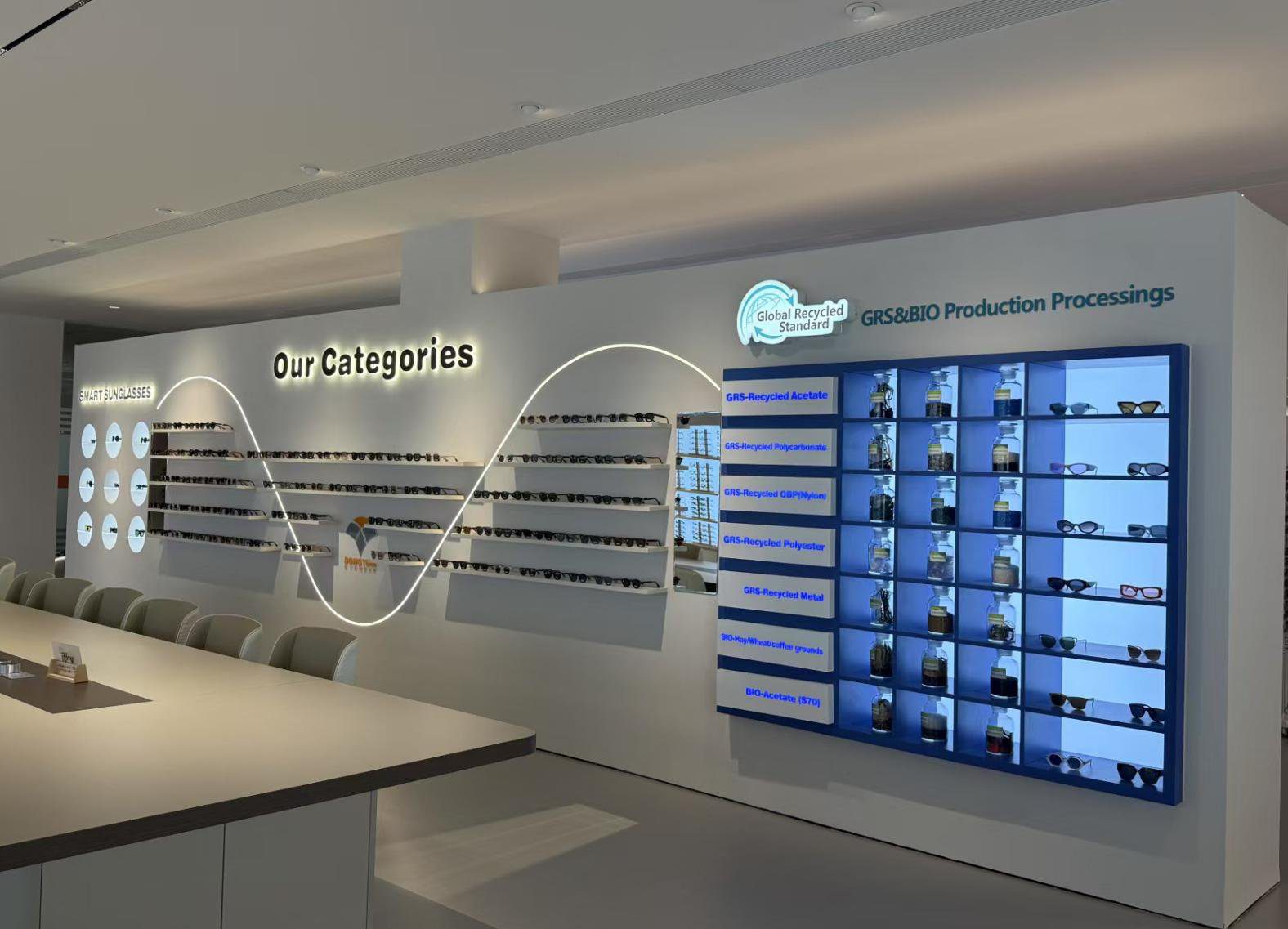
A factory’s sample room tells you a lot: the breadth of styles it has actually produced, the materials it works with daily, and whether its ODM catalog fits your brand direction. A manufacturer with thousands of physical samples on the wall — like the Dongtian sample room above — gives you a running start on style selection instead of starting from a blank page.
Step 7: Negotiate Terms That Protect Both Sides
Price is one line item in a real sourcing agreement. Negotiate the full package:
- MOQ: Typical eyewear factory MOQs run 300 pieces per order for custom production (sometimes per color/model). Reliable factories also offer ready-stock programs at lower MOQs (around 100 pieces) so new brands can test the market.
- Lead time: 75–90 days for OEM/ODM production is the industry norm; ready stock ships in 10–15 days. Anyone promising custom acetate frames in 30 days is cutting corners you will find later.
- Payment terms: The standard is 30% deposit, 70% balance against B/L copy. Be cautious of 100% upfront demands — and of factories that accept suspiciously low deposits (they may be desperate for cash flow).
- Incoterms: FOB is the default for most buyers; EXW shifts all logistics to you; DAP delivers to your door. Make sure your quote explicitly states the Incoterm and port.
- Quality agreement: Put AQL standards, defect liability, and remake/refund terms in the contract before the deposit — not after the first complaint.
Red Flags: When to Walk Away
Print this checklist. If a supplier hits two or more, keep looking:
- Refuses a video factory tour or in-person visit
- Cannot provide a business license, or the license scope is trading-only
- Quoted price is 30%+ below every other factory (someone pays for that difference — usually you)
- No testing equipment on site and no knowledge of ISO 12312-1 / FDA drop ball standards
- Certificates are expired, blurry scans, or registered to a different company name
- Samples are excellent but the factory resists a pre-production sample approval process
- Communicates only through personal WeChat/WhatsApp accounts with no company email domain
- Pushes for 100% payment before production
- Claims they can produce “any brand’s” designs (IP violations will become your legal problem)
- No verifiable export history to your target market
Frequently Asked Questions
How do I verify a Chinese eyewear factory without visiting in person?
Request a live video tour of the production floor, verify the business license scope (生产 vs 贸易), cross-check certification numbers with issuing bodies, and order physical samples. Third-party inspection services (SGS, TÜV, QIMA) can audit the factory for a few hundred dollars — cheap insurance before a five-figure order.
What is a normal MOQ for custom sunglasses or optical frames?
The industry norm is 300 pieces per order for OEM/ODM production, often structured as 100 pieces per color across 3 colors. Many established factories offer ready-stock programs from 100 pieces for market testing.
How long does eyewear production take in China?
Plan 75–90 days for OEM/ODM orders including material sourcing, production, and QC. Ready stock ships in 10–15 days. Sampling adds 7–30 days depending on whether new tooling is required.
What certifications should an eyewear manufacturer have?
At minimum: ISO 9001 (quality management), CE (for EU sales), and FDA registration (for US sales). For retail chain distribution, add BSCI or SEDEX social audits. If you sell sustainable collections, ask for GRS certification on recycled materials.
Is it better to work with a manufacturer or a trading company?
For private label and custom development, work directly with a manufacturer: better pricing, direct technical communication, and real quality control on the production floor. Trading companies can make sense for mixed-container orders across many product categories, but they add margin and an extra layer between you and your product.
Which region of China is best for eyewear manufacturing?
Wenzhou (Zhejiang) is China’s largest eyewear manufacturing cluster with a complete supply chain for acetate, metal, TR90 and PC frames plus lenses. Shenzhen specializes in high-end acetate and metal craftsmanship, and Danyang is the lens capital. For most brands, Wenzhou offers the best balance of quality, capacity, and cost.
The Bottom Line
Finding a reliable eyewear manufacturer in China is not about luck or connections — it is about running a disciplined vetting process. Define your product, verify the factory is real, audit capacity and QC systems, check certifications against issuing bodies, test communication through sampling, and negotiate complete terms.
The factories that welcome this scrutiny are exactly the ones you want to work with.
About Dongtian Eyewear: Founded in 1996 in Wenzhou, China, Dongtian operates 45,000 m² of manufacturing facilities across China and Thailand, with 4 production lines (acetate, metal, PC/TR90, and an in-house lens workshop producing 6.5 million lenses monthly) and a team of 1,000+ including 85 dedicated QC staff. We are ISO 9001, CE, FDA, BSCI, SEDEX, GRS and HIGG certified, exporting to 50+ countries — and we welcome every verification step in this guide, including factory visits.
Ready to start the conversation? Contact our team with your tech pack or reference samples. MOQ from 300 pcs for OEM/ODM (75–90 days) or 100 pcs ready stock (10–15 days), FOB/EXW/DAP terms available.